Thoughts on mercy, humanity, vulnerability, and beauty
I like to write. I don’t know if I’m any good. I like ee cummings, Beyoncé, John Keats, and Shakespeare. I think life is better than death, but perhaps I’m biased.
In high school, I refused to date. This might have been just as well, because I don’t know if I could have had I tried—I was just really weird in the there-aren’t-a-bunch-of-other-weirdos-just-like-me kind of way. For inspiration in my commitment to singleness, I relied heavily on Beatrice from Shakespeare’s Much Ado About Nothing, fully equipped with witticisms and snarky quips. However, as is the case with Beatrice, this was all posturing and had little to do with how I actually felt. I liked boys just fine and definitely wanted to get married some day.
However, there is a kind of power in being flippant and biting. You insert yourself into the human hierarchy this way. Those less equipped at wit must take their place lower than you and remain quiet onlookers to your verbal sparring, during art class when the teacher leaves the room for more than twenty minutes at a time. Anyone who ventures into this foray had best be well prepared, lest she be forced to creep back into sedges and tend her wounds.
Unlike other people who just have a mental list of desirable qualities, I actually wrote mine down and would refer to it if there was a boy who struck my fancy. And contrary to Beatrice’s catch 22, my impossibly long list of essential qualities that a man must possess in order to be worthy of me was made in complete sincerity. Most of the things that made the list were in the interests category: Shakespeare, fashion, poetry, language, dancing. Then there were other things regarding values and the number of children he’d prefer. This list took up pages.
Of course, in the process of growing up and discovering how to be human along with experiencing disappointed expectations, I realized that ideally, it boils down to something pretty simple:
There are couple things that I think matter regarding my own perspective of this film.
The first is that I have a somewhat more human connection to it than I have had to nearly any other film. I’ve met one of the producers. She is young and vivacious, and when I told her how much I enjoyed The Lego Movie, she responded graciously and then dragged her thumbs across each of her wrists in a slicing motion, saying something like, “It was like months and months of just slitting my wrists.” Normally, this would be off-putting and creepy, but she was way too charismatic for that.
In talking to her, I learned that this box-office hit was the brain-child of filmmakers batting in the biggest game of their lives so far (she’s part of a list of 18 producers). This was not pumped out by a corporate machine; Lego resisted making it. Lives were sacrificed, marriages neglected, health forgotten. So, my frame of reference for the making of this film has to do with people, not crunching box office numbers and Lego revenue.
The second thing is that I know a little history. Lego might have ceased to be. They were floundering with their old model of “build whatever you want with this set of bricks.” But cross-licensing was born in 1999 to revitalize the Lego brand and continue making Michael Chabon’s children’s pastiches possible.
There are a couple things I’ve noticed people are really, really good at: creativity and connecting to narrative. I’m not going to get into the nuances of what constitutes art—largely of sanity’s sake—but I think that there are a lot of films that qualify. I also think that The Lego Movie is one of them. What’s more is that I think that sometimes people who build things with Legos are making art. So there’s art.
Then, there are corporations, Lego (actually family owned), to be exact, possibly Warner Bros., too. Corporations are systems. They are chock full of resources and operations that allow those resources to be moved around. They are completely inferior to individuals in practically every way, except that it is these systems that allow for individual creativity, ingenuity, and art to be created and then experienced by other individuals.
They are, at their root, subverting typical toys by delivering them to their customers in the form of interchangeable pieces.
I think there are (for lack of a better term) bad people who run bad corporations whose chief operation is taking advantage of a lot of individuals for the benefit of just a few individuals (insert I am the 99% reference). Maybe this cross-branding and metatization is part of that evil (what an earlier generation would call selling out). Maybe the problem isn’t just that The Lego Movie exists, but that this kind of thing exists in too many areas of our lives.
The truth is, though, that Michael Chabon’s children did no better a job rebelling against the system than the Lego Movie did. The Lego Group knows that people often follow their instructions once and then build whatever they want after that. That is the genius of their toy! They are, at their root, subverting typical toys by delivering them to their customers in the form of interchangeable pieces. They also happen to have a brilliant marketing plan to go with it (connecting people to both narrative and the potential of creativity), one that will last through yet another generation—namely Michael Chabon’s children.
The Lego Movie is not attacking Lego as a corporation/authority. The Lego Movie is blasting individuals (President Business/Will Ferrell) who take such a narrow view of the world as to think that Lego creates instructions intending exclusively for them to be followed. And I think it is meta, post-modern genius, because Lego makes fun of itself in the process. I don’t care if it’s the same circus. I like this seat better.
If you want to actually rebel, you have to stop playing with Legos altogether. You have to go off the grid. You have to stop talking to other people, possibly find a completely different universe. If you aren’t prepared to do that, your idea will be co-opted. Someone who lives in a similar world, with similar experiences, will write about those experiences and they will show up in books, on the big screen, on the internet, and in toys. This is the result of our systems (and our creativity). This is the result of individuals who love to create and connect to narrative. This is the result of individuals who die unless they connect with each other. What is Lego? What is The Lego Movie? They are ways for us to connect.
So, about bad corporations: these are things we should rebel against. Not because systems, operations, and resources are bad things, but because we should create systems that are reflective of our need to create and connect. It’s ok to do as you’re told as long as what you are being told is good or produces goodness.
“…but till all graces be in one woman, one woman shall not come in my grace. Rich she shall be, that’s certain; wise, or I’ll none; virtuous, or I’ll never cheapen her; fair, or I’ll ever look on her; mild, or come not near me; noble, or not I for an angel; of good discourse, an excellent musician, and her hair shall be of what color it please God.”
-Shakespeare, Much Ado About Nothing
I often ask myself, why did Shakespeare stop there? Those are but a few of the requirements for any qualified suitor. There is so much more that is absolutely essential to tempt me.
Essential Qualities that a Man Must Possess in Order to be Worthy of Me
He should also have an insatiable appreciation for the arts, like underwater basket weaving and car wash bumper sticker art.
He has to have read The Story of Ferdinand and the entire Curious George canon, every version of The Three Little Pigs, and hate Harold and the Purple Crayon, until he’s read through to the end. He has to love Green Eggs and Ham, until he’s read it through to the end (I mean gross, Sam I am).
He must shop exclusively at Kohl’s and only wear one pair of shoes, except under extreme duress, like when he needs to prove a point or has been captured by dragons who breathed fire on the other pair he had.
He needs to have space monkeys and an Elvis suit for his black Pomeranian/Chihuahua mix. He needs to be a cat person (he only adopted the dog because it looks kind of like a cat and because it belonged to his best friend who tragically died in a freak gasoline fight accident).
When he says he likes long walks on the beach, he had better mean the entire coast of Chile. Or he could just hate beaches and have a really poor sense of direction.
He needs a completely disproportionate hobby, preferably one that takes up the entire guest bedroom and occasionally occupies his dining table, and maybe part of his roof, or a hobby that is a boat.
He has to sniffle with just one nostril at a time.
He must obsessive-compulsively say every word that an acronym stands for three times each, in alphabetical order, uncollated.
He has to be a wizard, or if he’s not he should be descended from one. He should also be descended from some kind of large predatory mammal like a lion or tiger or a cougar or a cheetah or a leopard or a wolf or a griffin or a lynx (this is not even an exhaustive list).
He has to be a master weaver and cottage cheese maker.
He has to know the answer to ALL the riddles.
He has to smell like naked trees shrouded by fog.
He has to pine for the simpler days of his youth, now 197 years ago, when adulthood is just too complicated and hard, even though it’s really just post hoc nostalgia and his childhood was terrible at the time. They didn’t even have summer back then.
He has to pretend to hate most dairy products because of being self conscious about the way they make him smell.
He has to be a chameleon.
He has to own an iguana that just swallowed an entire salamander and is now eyeing his Pomeranian/Chihuahua mix.
He has to think dry elbows are sexy—not the most sexy, just enough.
He has to know how to complete the following sentences:
Since today is our last day on Earth, I hope________________.
Cardboard boxes are best used for__________________.
The main thing cellphones and syphilis have in common is___________________.
Yes. Such a man would win any woman in the world, and I don’t think perfection is too much to ask.
When I was little, I wanted to be a famous fashion designer and design dresses for stars to wear to the Academy Awards and other classy events. I poured over People Magazine’s tribute to Oscar history and bought heavy bridal magazines (they had the best photo to dollar ratio and the fewest articles about how to lose five pounds or twenty ways to please your partner).
I drew. I painted. I imagined.
I became aware of your existence at a very young age. Much Ado About Nothing is one of the first films I remember watching. By the time I was in second grade, I had grown so attached to it that, for a class assignment, I listed it as my favorite movie. Perhaps it is somewhat scandalous that a seven-year-old would choose a movie that contains so much nudity in the first ten minutes. In which case, it may have been for the best that that my teacher had no idea what I was referring to.
As a child, I would get up and dance around the room, mimicking Kenneth Branagh’s movement as he celebrated in the fountain. I could quote every single line, reveling especially in Sigh No More, you sitting in a tree, and the delightful way the words came spilling from your mouth, as if every syllable was savoured as ambrosia.
At such a young age, I had not fully conceptualized that you and Beatrice were in fact different people. This realization began around the same time that I watched Sense and Sensibility, which became another favorite, rivaling even the six part BBC production of Pride and Prejudice. How I wanted to be Eleanor. How I wanted to be Beatrice. Then, there were other films, and in each one you made your character the most interesting person in the world with all the depth, breadth, and humor that real people have. You became this beacon of excellence in acting and film-making (two areas near and dear to my heart). You became my model of womanhood.
I can’t say that I know anything about your personal life, and I think we can agree that this is probably for the best. I don’t think I’ve ever seen you splashed across the cover of a tabloid, so maybe when you’re not working, you’re just really boring. Or maybe England is a little better about privacy. No matter; your work is wonderful.
Inevitably, on the first day of classes throughout high school, there would be a “getting to know you” portion, despite the fact that many of us had known each other since kindergarten. A favorite question during these things is this: if you could spend a day with any famous person who would it be and why? Typically, my classmates said things like Brittany Spears or someone from NSYNC or some sports star. I said Emma Thompson. Most sixteen-year-olds will give you strange looks when you say things like this. Now, I can say, “Professor Trelawney,” and people still think I’m weird, but they actually know who I’m talking about.
I didn’t want to meet you as a mere fan, though. Fangirls are so uncool. They just want autographs and handshakes and pictures together. They sound like they don’t know what they are talking about, and I’ve always found celebrity culture a little bit voyeuristic.
I imagined I would meet you once I had become a famous fashion designer. You would hear about me or see some of my designs somewhere, and you would have your assistant call my assistant. She’d say, “Ms. Thompson wants a dress designed by Ms. Burkitt. Is she free for lunch on such and such a date?” (obviously, I’d be living in London). Then we would talk about how to create a dress for a red carpet event or some gala that would show off your best features, and, at some point, during the very professional conversation, where we slowly discovered we were kindred spirits, I would casually but earnestly comment on loving your work and how the joie de vivre you so clearly have has etched itself onto my soul, making you a true inspiration. You would be oh so gracious, and our lunch would go long, and we’d both be late for our next appointments because we just couldn’t stop talking about the nature of beauty and art and story. Then, we would be bosom friends, and I would invite you to all my dinner parties.
You see, I am actually the worst kind of fangirl, the kind that isn’t satisfied with a handshake or an autograph because she recognizes that humans are so much more than a signature, a two-second smile that could be plastered on just for a good show (classy lady that you are, you wouldn’t let on if you were having a terrible day). And you who tell such incredible stories, either in writing or in acting them out, you have to be so human—crying the way you did in Love Actually, making us all want to listen to Joni Mitchell whenever we feel life is too heavy, and reminding us the way grief is actually expressed in private moments—not vapid, clinging to celebrity status, but embracing and embodying whole-hearted living. And what you do, story-telling, is so simultaneously the most vulnerable of things in the world and tremendously disproportionate. Your audience gets to see what—for all they know—is your heart and soul laid bare, while you know nothing of them. They are the anonymous many, while you are so particular to them.
I no longer have aspirations of fame, although I will still make you a dress anytime you want one. I am ever so much better at sewing than I was when I first imagined all of this. It would appear that, at the age of 25, it’s time to move on from my childhood fantasies. It’s time to keep preparing for grad school, working as an administrative assistant in the meantime. But I’ll keep watching your movies, in a parallel fashion to the way I still sleep with my stuffed elephant under my arm. And when I notice you’ve done something fabulous, like take your shoes off to present a Golden Globe, I’ll smile and think to myself, I bet meeting her would be amazing. I won’t tell anyone, but hope will still linger somewhere at the edge of my consciousness, where my childhood refuses to be completely snuffed out.
By ee cummings

somewhere i have never travelled,gladly beyond
any experience,your eyes have their silence:
in your most frail gesture are things which enclose me,
or which i cannot touch because they are too near

your slightest look easily will unclose me
though i have closed myself as fingers,
you open always petal by petal myself as Spring opens
(touching skilfully,mysteriously)her first rose

or if your wish be to close me, i and
my life will shut very beautifully ,suddenly,
as when the heart of this flower imagines
the snow carefully everywhere descending;

nothing which we are to perceive in this world equals
the power of your intense fragility:whose texture
compels me with the color of its countries,
rendering death and forever with each breathing

(i do not know what it is about you that closes
and opens;only something in me understands
the voice of your eyes is deeper than all roses)
nobody,not even the rain,has such small hands
Because there is evil in the world,
dear one, and brothers slay brothers, and men are cowardly, even in their words, hiding behind rhetoric and platitudes, and even less valiant in their actions; let me rest in your arms tonight and listen to the gentle rhythm of your life, defying this creeping despair.
Because fear and apprehension are wasted time,
a disservice to uncertainty, to humanity, to God,
a surrender to the tragedy,
a capitulation to the darkness;
let me stay by your side for whatever
minutes or hours or days or weeks
or months or years remain to us.
Oh darling, let me come Home.
Because there is beauty in the world,
casting the light of redemption—
when good is allowed to grow,
when heads and hearts forget
their fancied or fabled fear—
even on the darkness of death;
let me rest in your arms tonight,
becoming one within and without.
Because there is Love in the world,
whispering sight and sound and health,
overwhelming the grave, defeating defeat,
living every day as a gratitude,
a grace, a gift, a greatness;
let me sing, too, the susurrant hope
of the Creator and the created.
Oh darling, let me come Home.
People talk about unrequited love like it’s some kind of tragedy, like the person who loves is the one who is deficient. And it is a tragedy. We live in this broken world where we can’t predict or control everything, where love doesn’t always get to grow at the same rate or between the same people. But you have to give yourself permission to love who you love when you love them. That doesn’t mean you should negligently let someone else hurt you, and you shouldn’t become a stalker. Boundaries are important, but it’s ok to love at a distance, and it’s ok for that love to hurt, and it’s ok that it will fade eventually, even though you don’t want it to. And it’s ok to sometimes do something a little stupid for love’s sake, not because that’s what love is or what lasting, healthy relationships are founded on, but because our best lives are ones lived in love. So it’s ok if you decide to fight for it.
I have a friend who will sometimes pour us what she calls “let’s be honest” glasses of wine. These are very full—very full. I have yet to determine whether she wants to be honest about how much wine we want to drink in the first place or if she thinks that if we drink more, we’ll be more honest. Maybe it’s both.
Ok, so let’s be honest.
I don’t really like peaches. Sure, perfectly ripe peaches are divine, or at least point us in the right direction. Eating an under-ripe peach, I’m positive, is akin to eating squishy tree bark. Eating over-ripe ones: just don’t. I will admit there is a narrow window of acceptable peachiness. That version of peaches, I could eat until I die.
Unsurprisingly, I don’t like peach pie. What is worse than a raw peach that is outside of the acceptable ripeness window? Cooked peaches. This includes canned peaches. This includes peach cobbler. This includes all peach-flavored things. To quote an incredibly obscure song from an incredibly obscure musical I was in once, “Peaches have fuzz, and I don’t like ‘em cuz, they’re soft and squishy, kinda slimy like a fishy.” Mix that with a dry, heavy, crumbly crust, over-sweetened filling, and corn starch holding all the goo together, and you have a pretty terrible pie.
You can imagine my skepticism when my mom told me about this fantastic peach pie she had made. Even though there was no wine involved, I pressed her to be honest about why she thought this particular pie was so good.
My grandparents used to live in a house with a peach tree in the front yard. This provided a plethora of peaches in late summer, which my grandpa preferred to eat with cream. I decided to make the pie, not because I thought I would like it, but because it would give me a way to use up a lot of peaches. At the very least, my grandparents could enjoy the dessert.
I wrote down the recipe based on my mom’s instructions. I gathered ingredients. The crust called for lemon juice and butter instead of shortening, yielding the best crust I had ever come across. This was encouraging.
The filling called for mace.
I know what you’re thinking. Claire, don’t you use mace to ward off an attacker or scare away evil demons? The answer to this is yes. However, mace can scare away the demons of your soul when you eat it, by being delicious, because it’s made from the outer casing of nutmeg.
Additionally, the filling called for flour, not corn starch to keep the juices from being too oozy; it also called for an egg wash over the top crust.
The resulting pie was the best pie I have ever had.
It was gloriousness wrapped in a flaky, light crust that had been browned to perfection. The mace gives it a kick of spiciness—not too much. There wasn’t too much sugar, allowing for the best part of all: the peaches tasted like peaches. Sure, they were softer and warmer, but they still tasted like the sun-kissed glory that peachy perfection should be. It also doesn’t even need ice cream.
So now, when I make a pie, it’s a peach pie. I have made dozens by now.
I am a pie particularist, meaning I can get really picky about pie—about most dessert, really. So, when people offer me pie and I tell them I’m not really in the mood for dessert, the truth is that I am just not in the mood for that dessert—this is about honesty, after all.
I imagine there are other pie particularists out there. Maybe some of them think that peach pie can only be mediocre, inferior to the glory days of a finicky fruit. This recipe is for them. I have tweaked it slightly, but a similar recipe can also be found in The Gourmet Cookbook, edited by Ruth Reichl.
Let’s Be Honest Peach Pie For Crust
3 cups all purpose flour 3/4 tsp salt 1 cup (2 sticks) unsalted butter 1 Tbs fresh lemon juice 1/2 cup cold water
For Filling 3 lbs perfectly ripe peaches, pealed, pitted, and sliced 1/4 cup fresh lemon juice
3 Tbs rum 6 Tbs all purpose flour 3/4 cup brown sugar 1/4 tsp salt pinch of mace
2 Tbs butter
For assembly 1 large egg yolk 1 Tbs water
For Crust: in a large mixing bowl, mix flour and salt. Cut in butter with a fork or by hand until the butter is pea-sized or smaller and the mixture feels grainy. Add lemon juice and blend gently with a fork. Add cold water one Tbs at a time, blending with a fork until the crust is slightly sticky and all the mixture forms one lump of dough. Do not over-mix. For the most delicate crusts, the less friction created during the assembly, the better. Separate the dough into to pieces and form into disks about 1.5 inches thick each. One should be slightly larger than the other (this will form the bottom crust). Wrap each in wax paper and refrigerate for 30 minutes.
For Filling: in a large mixing bowl, combine peaches, lemon juice, rum, flour, brown sugar, salt, and mace. Be sure to stir very gently, tossing the peaches so they maintain their shape, being careful not to bruise them.
Preheat oven to 425°F.
For assembly: Remove crust from refrigerator. Generously flour your counter-top or pastry board. You should give yourself at least 18×18 inches. Take the larger piece of dough and roll it out, beginning from the center and pushing out. You may want to turn the crust over once or twice to ensure that it won’t stick to the counter. When you are finished, the crust should be even, less than 1/8 inches thick. Gently fold crust in half and in half again and transfer to a 10 inch pie plate. Unfold the crust and center it in the plate.
Add the peach mixture, spreading it evenly. Next, roll out the second piece of crust in the same fashion as the first. Instead of folding it, cut 1-1.5 inch wide strips and lay them across the top of the pie to form a lattice.
In a small bowl, mix large egg yolk with water. Using a pastry brush, slather the egg wash over the pie. Using a fork, press the edges of the crust together, then trim the excess crust with a knife.
Place pie on center rack and bake for 20 minutes. Reduce temperature to 375°F and continue baking for 45-50 minutes. Let cool for at least 1 hour before serving.
Don’t forget to eat the entire thing right out of the plate at least once.
There have been times, and maybe there will be again, when fear gripped me so tightly, that I struggled to breathe. I forgot everything else. I forgot to see. I forgot how to turn on the lights to scare away shadows. Those moments have shaped and rearranged me. I am not my anxiety. I am not my depression. But I carry them with me, even on the sunniest days, in the happiest moments.
The first time I had an anxiety attack, I was thirteen. This was right after a Sunday school lesson about demons, and I found myself wondering for months, maybe even years, whether I had experienced a demonic attack. It was a scary time, a time before my nightmares had stopped, a time before I knew how to have faith without positive emotions. I thought that if my emotions could be swayed so easily, my salvation and my Christianity were false. I questioned God’s existence, and, despite continuing to attend church regularly, I felt wildly alienated from it.
It happened just before I registered for seventh grade. I would be in a new school, in with the big kids (in my school district, 7th through 12th graders shared a building). I had been dreading growing up all summer and mourning the loss of my childhood. Finding comon ground with Peter Pan, I didn’t want to grow up at all.
It was a Sunday night. I had been lethargically spending my last days of summer, being as unstructured as possible. After the talk about demons, I had an uncomfortable feeling as I got ready for bed, a tightness in my stomach, a sense of dread pawing at the back of my head, right above my neck. I decided to sleep downstairs, on the main floor, instead of in my bedroom, upstairs. This is something I did often when I was younger due to frequent nightmares; I had grown adept at predicting when I would have one and preferred to be close to my parents’ bedroom. This way I could stay up late reading without keeping my sister awake, hoping I could ward off the various villains of my dreams with a book. I would eventually fall asleep, regardless of my efforts. Then, the nightmare would come.
This particular night it was different. It was dark and warm, as Augusts in Minnesota are apt to be. I laid out sleeping bags and tried to settle in, but I couldn’t. Instead of drifting into an unconscious hell, I was wide awake. My chest got tighter and my mind raced faster until I could no longer think. Fear was all there was. I felt paralyzed. Just the same, I forced myself through the kitchen and dining room—it seemed to take an eternity—into my parents’ room. My mom was still awake, a lamp lighting the room, providing some amount of relief from the terror of darkness just outside.
My mom looked at me and asked what was wrong. I don’t remember if I managed to say anything or if my face gave away my distress. Then my mom prayed. She prayed and prayed. I threw myself on her bed and cried. Eventually, I began to breathe normally again. The gripping sensation in my chest subsided. My mind calmed and I focused on the words my mom was saying, the love and concern in her voice, the reassurance.
My mom began to sing a song that I had heard ever since I was little “Jesus has all authority here in this place, He has all authority here, for this habitation was fashioned for the Lord’s presence, all authority here.” It was immensely comforting.
For the rest of the night, and for several nights after, I slept on the floor in my parents’ bedroom. I would fall asleep holding my mom’s hand.
In the following months, I seemed to lose my identity, my sense of grounding. I didn’t trust anything I thought or felt. Seventh grade began, which was difficult enough; new classrooms, new teachers, new classmates, a whole new way of life. And while cruelty exists among children of all ages, suddenly cruelty was coupled with extreme emotions and the makings of deeply rooted insecurities. For the most part, I could handle the blonde girls with straight hair who had icy stares and snide comments. I could handle the guy from Illinois, (who I thought was kind of cute) calling me ugly “as a joke” every day. Even then, I knew these things were ultimately unimportant.
What I handled less well was the existential angst I was undergoing. I hadn’t discovered Descartes yet, so my eyes hadn’t been opened to the ultimate good that comes out of doubting everything; and I really, really wanted to be a good Christian. I wanted God to exist. I wanted my faith to be real.
I did not know then that my depression was probably made worse because of some vague impression I had that Christians were supposed to be cheerful. I had had little to no exposure to healthy attitudes regarding depression. Mental health was a taboo and framed as a spiritual affliction, not a chemical imbalance. Even when my youth pastor resigned that year due to his wife’s depression, he skillfully skirted around the word, talking instead about stress and serotonin levels. For many evangelicals, maybe even people in general, negative emotions are associated with feelings of shame, when the reality is that negative emotions are healthy in light of negative life events. You can have negative emotions without abandoning hope, and you can forget your hope without abandoning God or the church. What’s more, you will not be abandoned because of these things.
These were things that I did not learn for years after seventh grade. They are things that I am still learning. This keeps my depression more or less at bay, and my anxiety attacks are short and relatively irrelevant. As a thirteen-year-old I used the tools I had available to me, which, while shoddy, have made a significant difference.
The first tool was logic: If God exists, God exists whether or not I believe it. Unless you are hardcore into Berkeley or some other form of idealism, this is pretty basic. I would repeat this to myself to prevent going down mental rabbit holes even Alice would probably have shunned. While I didn’t realize I was being intensely philosophical, this premise became a significant step in the process of understanding the relationship between belief and ontology. That simple sentence was an existential lifeline.
So I had tackled the notion that existence was belief-independent. However, my work was far from over. I had to tackle the eerie feeling that perhaps my experience of God was completely false, and that I was really being tricked by some demon, possibly without an actual will of my own, heading down a path of complete destruction and eternal torment.
No big deal. Buffy deals with this kind of thing in her sleep, right?
I remember sitting in the bathtub one day. I was nearly through my seventh grade year, and I had stayed home from school. I was staring at the faucet sticking out of the wall. The water looked almost as if it were tinted blue-green as it lapped gently against the sides of the bathtub. My mind was turning over and over again, stuck and numbed and terrified.
Suddenly I thought of something I had heard in youth group, “God is not a God of confusion.”
For the first time in months, I felt that I could trust my senses and emotions. Sure, sometimes they jumble things up and get it wrong. They don’t always match reality, but for the most part, I can trust my experiences. However defective these tools are, they worked. They gave me enough space to breathe and enough time to sort through other big questions as time went on, without a sense that I was somehow failing all of the time.
I slowly rebuilt trust in my mind, trust in God.
Today, I don’t know how many anxiety attacks I have had. They usually erupt out of an unbearably deep sense of loneliness, at times of great uncertainty, not a fear of the demonic. Lately, they have had an affinity for grocery stores as well.
I have close friends with anxiety who have taught me a lot. Recently, I’ve learned that I have a lot of family members who have anxiety. Some are medicated; others aren’t. Some see therapists; others don’t. Still others don’t even recognize their constant sense of fear as having anything to do with mental health.
Talking about it, sharing my fears, and learning from others’ experiences have all helped me shed some light on those midnight monsters that tried to steal the last moments of my childhood. Despite all the weird and destructive instruction from that Sunday school lesson all those years ago, one things was true: beastly, dreadful monsters cannot live in the light.
Yes, sometimes, I have to fall out of love, and this falling is less than thrilling, more a slow tumble down a steep decline, as I cry out the words that have meaning only to two other ears,
hoping he will throw himself down after me.
Then, dizzy, and scraped, and bruised a little,
I brush myself off and grin.
With a smirk and a tell-tale twinkle I say,
“That was fun; let’s go again.”
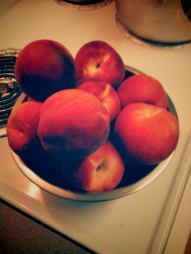 I don’t really like peaches. Sure, perfectly ripe peaches are divine, or at least point us in the right direction. Eating an under-ripe peach, I’m positive, is akin to eating squishy tree bark. Eating over-ripe ones: just don’t. I will admit there is a narrow window of acceptable peachiness. That version of peaches, I could eat until I die.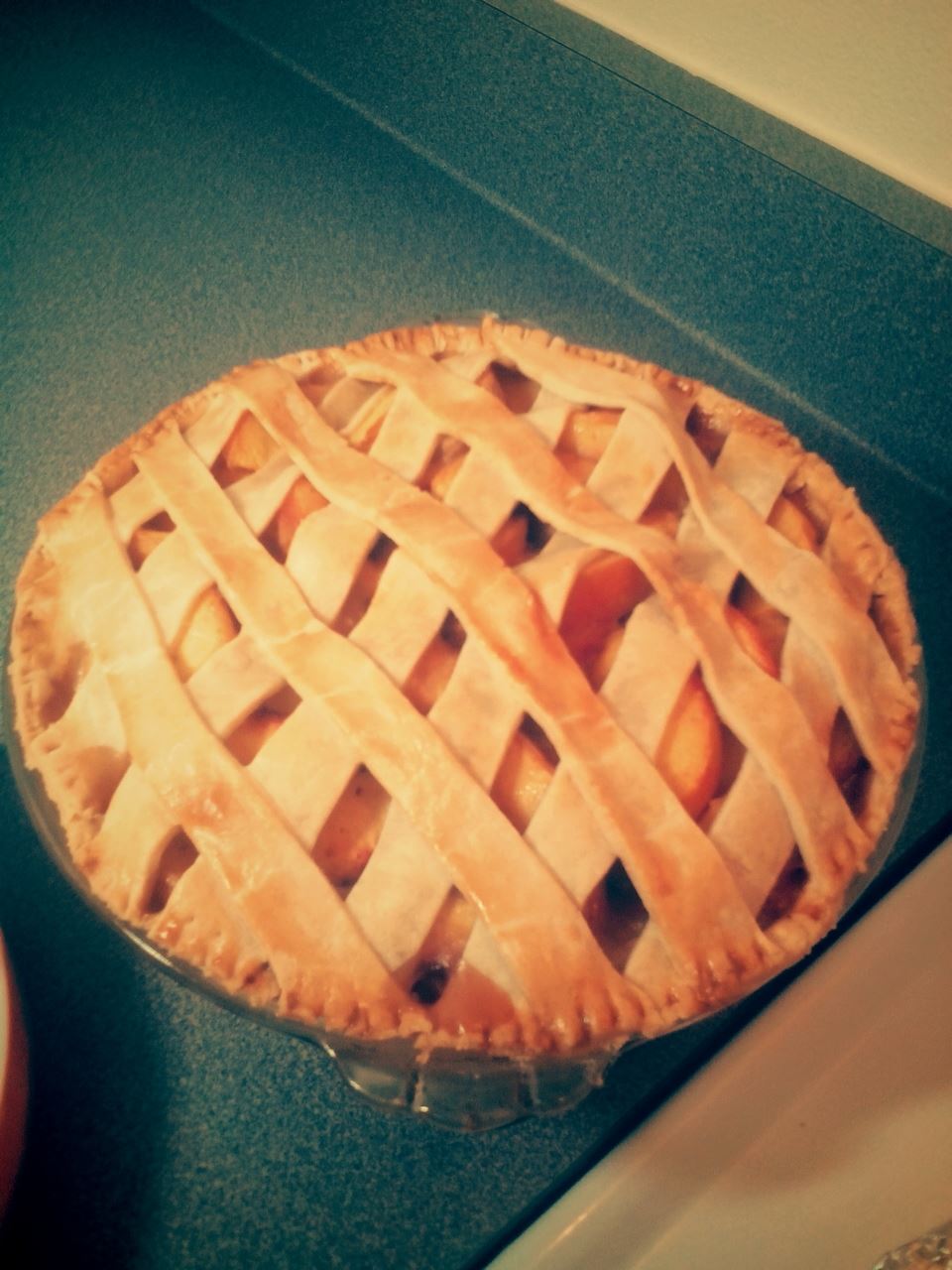
 An Indomitable Grace